Port of Miami Cruise Parking Guide
The barrier at the exit plaza does not open for debit cards. Bring a credit card or cash for the exit. Port of Miami cruise parking is otherwise one of the easiest things about sailing from here, and this page is the detail: what each garage costs, how you pay, when the off-site lots are worth it, and the handful of rules that catch people out.
Prices were checked in October 2026. Port parking rates are set by the terminal operator and revised most years, and the off-site lots reprice constantly, so treat the numbers as the right order of magnitude and confirm before you travel. The full picture of sailing from here is in our Port of Miami cruise port guide.
At a Glance
| Question | Answer |
|---|---|
| Where are the garages? | Directly beside each terminal. No shuttle, no remote lot. |
| What does it cost? | $28 per day in garages C, D, F and G; $35 at garages AA (MSC) and B (Norwegian); Garage A has its own rates |
| When do you pay? | On exit, when you come home |
| What do they take? | Major credit cards and cash. Not debit cards. |
| Can you reserve? | Not through the port; a couple of lines sell garage space in their own booking flow |
| Off-site alternative | $8–$16 per day with a free shuttle every 15 minutes |
| Oversized vehicles | Surface Lot E, $25 per space per day ($50 if the vehicle takes two spaces) |
| How long can you leave a car? | No maximum stay; you pay the accumulated daily rate |
| Time to allow | Extra on embarkation morning; traffic sets the real figure |
How Port Parking Actually Works
PortMiami is unusual among big cruise ports in that the parking is genuinely convenient. Each terminal has a multi-storey garage immediately beside it — in most cases you can see the terminal door from the garage stairwell. There is no shuttle bus, no separate lot a mile away, and no handing your luggage to someone at one end and hoping to see it at the other.
The sequence is straightforward. You come onto Dodge Island by the Port Boulevard bridge or the PortMiami tunnel, follow signs for your terminal letter, take a ticket at the garage entrance, park, and walk across to the terminal with your bags. You keep the ticket. On the day you return, you drive down, join the queue at the exit plaza and pay the accumulated total there.
Two consequences follow from that design and both matter. First, you need to know your terminal letter before you arrive, because the garages are terminal-specific and the island is two miles long with no easy way to turn around. It is on your boarding pass. Second, because there is no shuttle in the loop, the thirty minutes you should allow is genuinely thirty minutes — park, unload, walk — rather than an unpredictable wait.
What It Costs, Terminal by Terminal
Rates vary by terminal rather than by the length of your sailing in most cases, and they cluster in a band.
| Terminal group | Typical 2026 daily rate |
|---|---|
| The standard garages (C, D, F, G) | $28 per day |
| Royal Caribbean, Terminal A | $25 per night for sailings of 6+ nights, $28 per day for 5 or fewer |
| The newer MSC and Norwegian garages | Around $35 per day |
| Buses and oversized vehicles | Higher; charged at the oversized rate |
Run the arithmetic on your own sailing before you decide anything, because the totals get large quietly:
- A 4-night Bahamas cruise at $28 a day: roughly $112 to $140.
- A 7-night Caribbean cruise at $25 a night: roughly $175 to $200.
- An 11-night Southern Caribbean sailing at $35 a day: comfortably over $380.
At the top of that range, port parking costs more than a cabin upgrade, which is the point at which the alternatives below stop being a matter of thrift and start being obvious.
Paying: The Debit Card Problem
The exit booths at PortMiami accept major credit cards and cash. They do not accept debit cards. This is not a quirk of one garage or a temporary system fault — it is how the port operates, and it is consistent across the terminals.
What to do about it:
- Bring a credit card, and bring it with you rather than leaving it in the cabin safe on disembarkation morning.
- Or bring cash — enough for the full stay, not roughly enough. There is no cash machine at the exit plaza.
- Check the card is not expiring during a long sailing. It happens.
- Tell your bank you are traveling if the card is issued outside the United States, because a large unfamiliar charge appearing after two weeks of foreign transactions is exactly the pattern fraud systems block.
If you do arrive at the barrier without a working payment method, the attendants deal with this often and there is a process — but it involves leaving the lane, sorting it out on foot, and a queue of people behind you who have flights to catch. Avoidable.
Reservations
PortMiami’s garages do not take reservations through the port itself. They run first-come, first-served, and on peak turnaround days — Saturdays in January and February, the weeks around Christmas and spring break — a garage can fill by late morning.
Two lines sell garage space as part of their own booking flow, so it is worth checking your cruise line’s site under pre-cruise add-ons before you assume you cannot pre-book. What you should not do is rely on a third-party site claiming to reserve official port garage space; the off-site operators genuinely do take bookings, and the confusion between the two is where money gets lost.
If your sailing falls in a peak week and you are not comfortable arriving on spec, that is the strongest argument for the off-site option below.
Off-Site Park and Cruise Lots
This is the part of the subject the port’s own signage does not mention, and it is where most of the savings are.
A cluster of commercial lots operates within a few minutes of the port, and they run free shuttles to every terminal roughly every fifteen minutes on turnaround days. Rates run from around $8 to $16 per day — between forty and fifty percent cheaper than the port garages, and sometimes better than that.
How they work
- Book online in advance. Booking ahead is the safer way to get a space at the rate you were quoted; walking up costs more where it is possible at all.
- You pay when you book, which sidesteps the debit-card problem at the port exit entirely.
- You are dropped at the terminal door with your luggage, and collected from the same place on your return — you call or text the operator when you clear customs.
- Covered and uncovered options usually exist, with covered costing a few dollars more. In Miami sun over two weeks, that is not purely cosmetic.
The trade-offs, honestly
You are adding a shuttle leg at both ends — fifteen to thirty minutes each way including the wait, and on a busy disembarkation morning it can be the longer end of that. You are trusting a commercial operator with your car rather than the port authority. And the quality varies: some of these lots are well-run and well-lit, others are a fenced yard. Read recent reviews rather than booking on price alone.
The rule of thumb: for a three- or four-night cruise the saving is $40 to $70 and the port garage is worth the convenience. For a seven-night sailing the saving is over $100. For anything ten nights or longer, the off-site lot is the obvious answer unless you have a specific reason not to.
Oversized Vehicles, RVs and Trailers
Anything over roughly twenty feet counts as oversized at PortMiami and does not go in the standard garages — the clearance heights and turning circles do not allow it.
- Surface Lot E takes oversized vans, RVs and vehicles with trailers.
- Rates are higher than the standard car rate and may be charged per length band.
- Trailers are generally charged separately from the towing vehicle.
- Space is finite and it is not reservable, so arrive early. This is the one category where turning up at 13:00 on a Saturday is a genuine risk rather than an inconvenience.
If you are traveling in an RV, several of the commercial lots north of the port handle oversized vehicles more readily and at better rates than the port does, which is worth a phone call before you commit.
Accessible Parking
Every PortMiami garage has accessible spaces, and they are positioned close to the walkways across to the terminal — a meaningfully short distance rather than a token gesture. A valid disabled parking permit or plate from any US state is recognized.
Two practical notes. Accessible spaces are not reservable and do fill on busy turnaround days, so arrive at the start of your window rather than the end. And if you are traveling with someone who cannot manage the walk across from the garage, the terminals all have a drop-off area at the door where you can unload first and park afterwards — do that, rather than trying to solve it at the garage end.
Timing: When to Arrive
Allow thirty minutes between reaching the port entrance and being ready to walk into the terminal. That covers the queue at the garage entrance, finding a space a few levels up, unloading, and the walk.
On the busiest days, when many large ships turn around at once, allow extra time. You can usually tell from the Port Boulevard bridge: if it is backed up at 11:00, the garages will be busy too.
Beyond that, the same advice applies as to boarding generally. Arrive inside the window on your boarding pass, aim for the earlier part of it, and remember that the 13:30 to 15:30 slot is the quiet one — shorter queues at the garage as well as in the terminal.
Leaving a Car for Two Weeks
There is no maximum stay in the port garages — you simply accumulate the daily rate. A few things worth doing before you walk away from a car for a fortnight in South Florida:
- Park under cover where you have the choice. Two weeks of Miami sun and daily afternoon storms is hard on a dashboard and harder on a rental car return inspection.
- Take everything visible out. The garages are staffed and monitored, but an empty seat is still the best deterrent.
- Photograph the car and the level number. Multi-storey garages all look the same after a week at sea, and the photograph settles any disagreement about pre-existing damage.
- Consider the battery if the car is old or the trip is long. A jump start at the exit plaza is an unhappy end to a holiday.
- Electric vehicles: charging provision at the port is limited and should not be relied on. Arrive with enough range to get home, or plan a charging stop on the way out.
When Not to Park at All
For a lot of people the right answer is not to bring a car to the port.
| Situation | Better option |
|---|---|
| Flying in, one or two people | Rideshare from MIA, $25–$45. Never bring a car near the port. |
| Flying in, family of four or five | Shared shuttle or a cruise line transfer; compare totals, not per-person rates |
| Driving from elsewhere in Florida | Off-site lot for anything over five nights; port garage for shorter |
| Staying a night before anyway | An airport hotel package with free week-long parking and a shuttle |
| Someone can drop you | The terminal drop-off lane, which is free and takes two minutes |
| Renting a car for pre-cruise days | Return it to a downtown branch, then rideshare to the port |
That last one is the most commonly missed. If you have hired a car for a few days in Miami before sailing, returning it at a downtown or Brickell branch and taking a ten-minute ride to the terminal is almost always cheaper than paying to park it for the length of your cruise — and it stops the rental clock. Our Miami car rental guide covers the branch locations, and the Miami parking guide covers everywhere else in the city.
The airport-hotel packages deserve a specific mention too. Several hotels in the MIA cluster include free parking for the length of your cruise plus a shuttle to the port, and when you price a room you were going to book anyway against a week of port parking, the package frequently wins outright. Our where to stay in Miami guide covers the neighborhoods, and budget tips has more of this kind of arithmetic.
If Something Goes Wrong
Three situations come up often enough to be worth planning for.
You lose the ticket. Not fatal. The exit booths handle lost tickets routinely, but expect to be charged a maximum daily rate for the full period rather than the actual one, and to need identification and the vehicle registration. Photograph the ticket on your phone when you take it — the whole problem disappears for the price of two seconds.
You miss the ship. Your car sits in the garage accumulating the daily rate until you come back for it, which is the least of your problems in that scenario but worth knowing. There is no need to contact anyone about the car; the meter simply runs.
The ship returns late. Weather, a medical diversion or a slow customs clearance can push disembarkation back by hours or occasionally a day. The garage charges what has accrued at the barrier, automatically. If you are on a tight connection, the parking is not the thing that will delay you — but the extra day is a real, if small, cost.
One more, less often: a car that will not start. The garages are staffed and jump starts are a routine request, so ask at the booth rather than flagging down strangers. Roadside assistance can reach the garages, though getting a truck onto the island on a busy turnaround morning takes a while.
Honest Verdicts
- The port garages are worth the premium on short cruises and hard to justify on long ones. Somewhere around six or seven nights the sums flip.
- The debit card rule is the most important sentence on this page. Nothing else here will actually ruin your morning.
- Do not pay for “guaranteed” port garage reservations from a third party. The port does not sell them. The off-site lots genuinely do take bookings, which is a different thing.
- Covered parking is worth the few dollars for anything over a week. Miami sun is not a rhetorical flourish.
- If you are flying in, do not rent a car at all for the port leg. It is the most expensive way to travel nine miles ever devised.
- Arriving early does not get you a better space. The garages are big; the terminal windows are the constraint. Come inside your slot.
Frequently Asked Questions
How much is parking at the Port of Miami?
Garages C, D, F and G charge $28 per day, garages AA (MSC) and B (Norwegian) charge $35, Surface Lot E is $25, and Garage A has its own rates. Off-site lots a few minutes away run $8 to $16 per day with a free shuttle.
Can I pay with a debit card?
No. The exit booths take major credit cards and cash only. Bring a credit card or enough cash for the whole stay, and have it with you on disembarkation morning.
Do I pay when I arrive or when I leave?
When you leave. You take a ticket on the way in, keep it, and settle the accumulated total at the exit plaza when you come home.
Can I reserve a space in the port garage?
Not through the port — the garages are first-come, first-served. A couple of cruise lines sell garage space through their own pre-cruise booking, so check your line’s site. Off-site lots take bookings freely.
Is there a shuttle from the parking to the terminal?
There is no need for one. The port garages sit directly beside their terminals and you walk across with your luggage. Off-site lots run their own free shuttles every fifteen minutes or so.
How early should I get to the parking garage?
Allow extra time between the port entrance and the terminal door, especially on the busiest turnaround days, because traffic sets the real figure. Arrive inside the window on your boarding pass rather than before it.
Where do RVs and trailers park?
Surface Lot E, at $25 per space per day, or $50 when the vehicle takes two spaces. It is not reservable and it does fill, so arrive early — or call one of the commercial lots north of the port, several of which handle oversized vehicles better.
Is it safe to leave a car at the port for two weeks?
Yes. The garages are staffed and monitored and there is no maximum stay. Take valuables out, photograph the car and your level number, and park under cover if you can.
What if my ship gets in late and the parking bill is higher than expected?
You pay the accumulated daily rate as calculated at the barrier, so a late arrival can add a day. It is charged automatically; there is nothing to arrange in advance.
Each garage belongs to a specific terminal, which is why knowing your terminal letter matters before you take a ticket at the barrier. Our PortMiami terminal guide runs through all ten terminals.
The smoothest way to combine parking with boarding is to drop passengers and bags at the terminal curb first, then park. Our guide to embarkation day at PortMiami walks through the rest of the morning, from porter tips to the first afternoon aboard.
Related Miami Guides
- Port of Miami Cruise Port Guide — terminals, transfers, embarkation and everything else about sailing from here.
- Parking in Miami — the rest of the city, where the rules are completely different.
- Miami Car Rental Guide — including which branch to return a car to before a cruise.
- Miami International Airport Guide — if you are flying in rather than driving.
- Where to Stay in Miami — including the airport packages with free week-long parking.
- Getting Around Miami — why there is no transit option to the terminals.
- Miami Budget Tips — more arithmetic of this kind.
- What a Miami Trip Costs — the wider picture.
Photo Credits
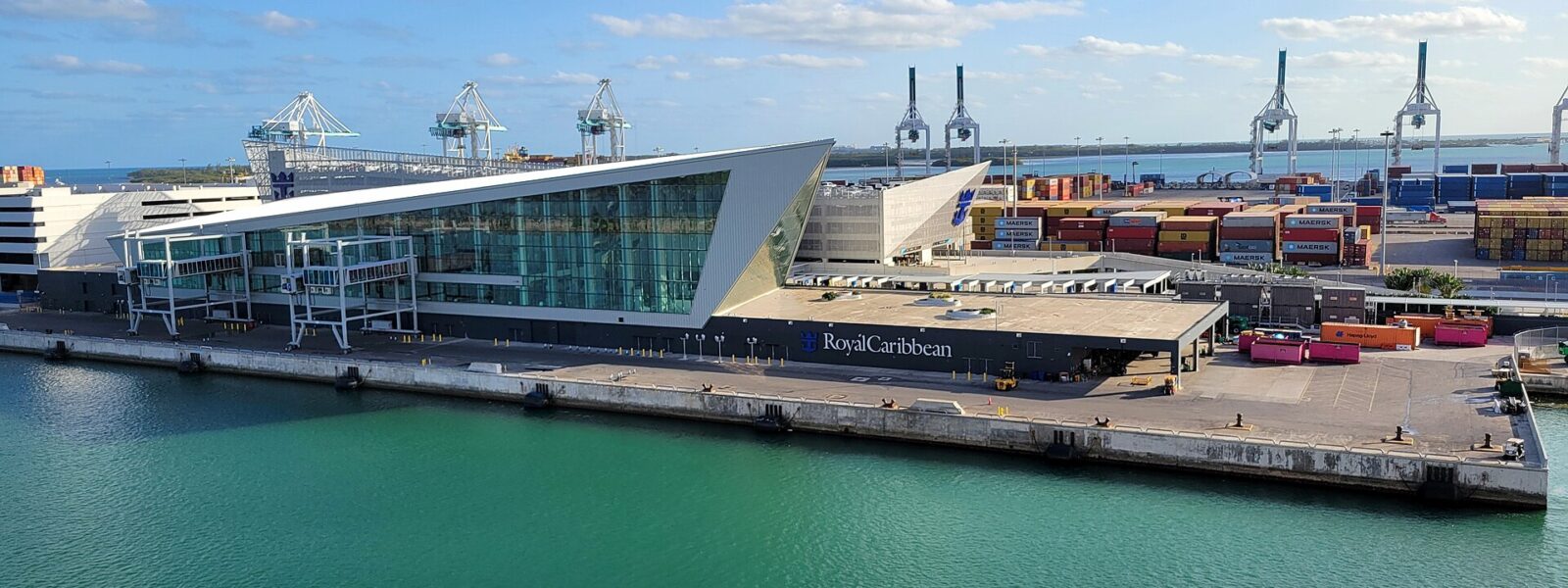
Royal Caribbean’s Terminal A: Royal caribbean Terminal A at PortMiami (March 11, 2024) by Kiran891, CC BY-SA 4.0, via Wikimedia Commons.
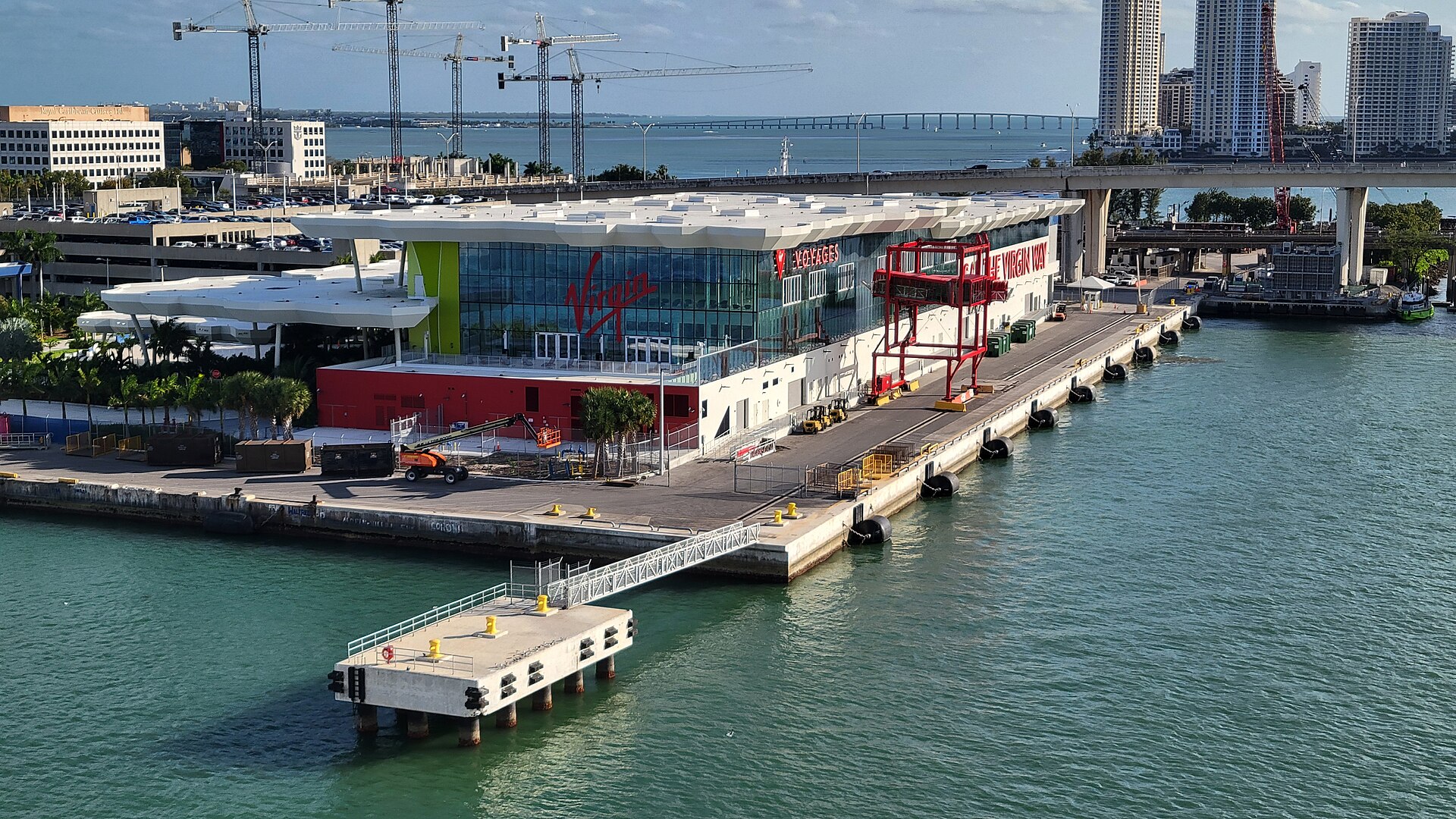
Terminal V and its garage: Virgin Voyages Terminal V at PortMiami (March 11, 2024) by Kiran891, CC BY-SA 4.0, via Wikimedia Commons.
Remaining photographs from the miamitourism.org library.